Meditation & practice
Meditation
Chanting
The Kahuna
Magical Discipline
Throughout the world, all the ancient teachings agree - any Kahuna, Shamanistic, or magical discipline requires that the Kahuna be able to enter an altered state rapidly and at will. But what kind of an altered state? The word Kahu-na will give us a clue. Na means "quiet, calm, centered." So some kind of ability to enter a calm centered state is what is necessary. But that in itself is not really quite enough in Huna.
Ha Breathing
The Teaching Of HA-WAI-I
When the first Haole arrived at the Island of Hawai'i, he came ashore, and asked the first Hawaiian he saw, "What's the name of this place? Where do you live?" The Hawaiian answered, "Hawai'i." Then the sailor went to another area of the Big Island and asked the next Hawaiian he saw, "Where do you live?" The second Hawaiian said, "Hawai'i." And then a third, with the same answer, so the island was named "Hawai'i." What each Hawaiian meant was, "I live in the supreme Mana that rides on the life's breath." When the sailor visited the next island, he asked the first Hawaiian he saw, "Where do you live?" This Hawaiian said, "Hawai'i." And then another island and another, and still the same answer, "Hawai'i." So Captain Cook named all the Islands, "Hawai'i." But Hawai'i isn't just a place in the middle of the Pacific, it's a place inside you -- a place that, wherever you go in the world it is still inside you. You see, what the Hawaiian was saying was, "I live in: Ha: meaning breath, or breath of life Wai: meaning water, but also a code word for Mana or life force, and 'I: meaning supreme
Hakalau
Active Meditation
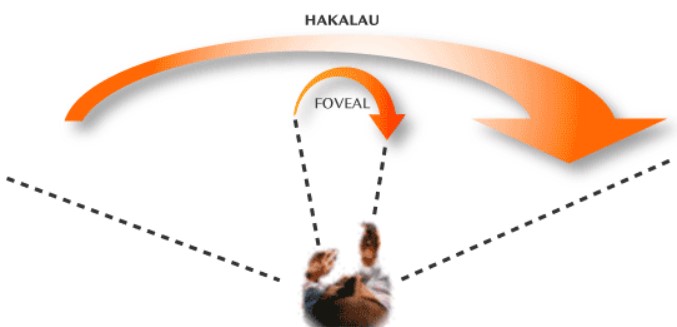
One meaning of Hakalau is, "To stare at as in meditation and to allow to spread out." If you've never tried it before, right now, this technique can be a real eye opener.
- Ho'ohaka: Just pick a spot on the wall to look at, preferably above eye level, so that your field of vision seems to bump up against your eyebrows, but the eyes are not so high so as to cut off the field of vision.
- Kuu: "To let go." As you stare at this spot, just let your mind go loose, and focus all of your attention on the spot.
- Lau: "To spread out." Notice that within a matter of moments, your vision begins to spread out, and you see more in the peripheral than you do in the central part of your vision.
- Hakalau: Now, pay attention to the peripheral. In fact, pay more attention to the peripheral than to the central part of your vision.
- Ho'okohi: Stay in this state for as long as you can. Notice how it feels. Notice the ecstatic feelings that begin to come to you as you continue the state.
Hi'olani
Sitting Meditation
The Kahuna, Kapihe was quoted in 1850, as saying, "E iho ana o luna. E pii ana o lalo. E hui ana na moku..." Kapihe, 1850 We believe that this translates as, "Bring down that which is above by means of the light. To ascend, take from darkness into light all that which is below (in the dark areas of the unconscious mind) by means of light. This will integrate all the islands (all the parts inside you), transforming the spiritual energy as it flows from the source and giving you peace." Another ancient chant gives a more specific technique:
"Kaa akau, kaa hema. Ku makani hai ka lani. Hekili kaakaa i ka lani."
"Roll the eyes up to the right, roll the eyes up to the left. Lift the eyes straight up to open up the heavens. Let flow the fine rain, roll the eyes up to stare at the heavens." Here are the specific steps to Hi'olani (or meditation):- O ku'u: Find a comfortable place to sit -- in a chair or on the ground will do. Darken the room, or cover the eyes so that no external light gets in. (This is important, at least the first time you do it.)
- Ha: If you wish, begin by doing 5 to 15 minutes of Ha breathing as described above.
- Ka'a: Roll the eyes up and to the right, then up and to the left, and then straight up to the heavens. Focus the eyes without strain, as if looking up at the sky, on the space between the eyebrows. (You can roll the eyes up even more if it is comfortable.) Remember the feeling of Hakalau, and take that into meditation with you.
- Kala: E iho ana o luna. As you look up to the space between the eyebrows, focus on the light. Pay attention to the light, let the light come to you, welcome the light. Watch the light. (If as you begin, you do not see the light easily, just press lightly on your eyeballs pushing them up and inward). Then let go, and watch the light.)
- Kuu: "To let go." Now, just let go and watch the light. If there are other thoughts, and the light is still there, that's OK. If you've forgotten to pay attention to the light, gently bring your attention back to the light.
- No'o: At the same time, meditation; concentration on the light. No'ono'o: Thought, reflection, thinking, meditation -- to think, reflect, meditate, concentrate on, and consider the light.
The Philosophy Of Meditation
Meditating on the Light
It is the inner light, and the inner light alone that can ultimately take us by the hand, and deliver us to the Great Light. This is where we came from, and ultimately where we will return. Truly it is where we desire to be now. Reaching the source of all light in and of itself is a supreme achievement, worthy of a lifetime of meditation. To bring an experience like this to our conscious awareness, so that it does not pass us by like a flash of lightning, it is necessary that we are prepared for its dawning. Ho'o puka e ka la, ma ka hikina!
Why We Chant
Opening the Heart
Once, a Kahuna who had been a student of Daddy Bray's, asked, "Why do you chant those old chants, why don't you let them die?" "Because they won't die," we replied. Even today they still call to us to be chanted. Daddy Bray chanted nearly every time he taught Huna. So why do we chant? We chant because chanting opens up the heart, and makes it swell and expand. At the deepest level of the meaning of the chant there is a vibration that corresponds to the meaning, and chanting opens up the neurology to that vibration.
Someone asked Swami Muktananda (an Indian swami, and master teacher of meditation) why he chanted and taught chanting, and he said, "We chant because without the chant, the heart of a yogi becomes as dry as a leaf in the fall, and as brittle, too." The theory of chanting in both the Hawaiian system and the Sanskrit system says that the sounds being chanted, the tonal patterns and the frequency of the vibration of the sounds, invoke in the neurology of the listener and also the chanter, the deepest spiritual essence of what is being spoken of in the chant.
The Connections
The Neurology of Chanting
Remember listening to a song, and notice that each word has a certain vibration in addition to the tune. In a Hawaiian chant, the vibration of the word has the same frequency as what is being spoken of at the deepest level of the chant. The ancient languages including Hawaiian, Greek, Latin, Hebrew have this effect. English does not. Statistics show that attendance of Sunday Mass dropped significantly when the Latin was eliminated. English, on the other hand, is a modern language, and so does not carry the same vibrations at its deeper level of sound as do the ancient languages.
We have 10 to 10 to the 11th possible neurological connections inside our body, according to Dr. Paul Goodwin, Neurophysicist, at Alaska Pacific University. We only use 10-15% of them, he says. But what do you think the rest of the neurology is for? To be developed, we believe. Chanting does that, making new neurological connections which allow the experience of subtler levels of creation and vibration.
Chanting and Huna
Why It's Important
We include chanting because by hearing the chants, every single pattern of sounds connects a certain set of neurology inside. So, simply hearing the sounds of the chants establishes certain neurological connections that you may have had before but do not currently have. If you have them already, then it strengthens those neurological connections. Simply put, we chant to expand our neurology and attune it to spirit, and to expand our consciousness.
The Deeper Meaning
Huna and Language
The English language has 22 consonants and 7 vowels. The Hawaiian Language has 7 consonants (plus the glottal stop which is counted as a consonant by some linguists) -- h, k(t), l, m, n, p, w, plus the 5 vowels -- a, e, i, o, u. When you look at the structure of the Hawaiian language, from what you have seen here, you begin to notice that there are very few consonants. In fact seven or eight consonants and all the vowels makes the language extremely simple. But the other thing about the language being that simple is that it's necessary for each single word to have a number of different meanings. Each word will need to have more meanings than English, some up to seven or eight meanings. Each word in Hawaiian has to do 3 or more times the work to produce the same meanings in Hawaiian that it does in English. This may have made Hawaiian the first phonologically ambiguous language.
Ho'opuka
Learning to Chant
Let's get started chanting. If this is the first time you have ever chanted, you may want to start with the vowels. In Hawaiian, here's how each vowel sounds:
- A = ah (as in "ha, ha")
- E = eh (as in "check")
- I = ee (as in "team")
- O = oh (as in "home")
- U = oo (as in "who")
Even when vowels are doubled up, such as in the Hawaiian, "oo" it is still, "oh-oh," and not "oo." So, to start, you may want to chant the vowels, as each beginning chanting student does. Stand up, take a deep breath, and chant "aaaaaaaaaaa" for the entire breath, and then continue with each of the vowels. Repeat. Continue for five minutes. Notice the feelings inside as you chant. Pay attention to other parts of your body. How are they affected? Each vowel activates a different part of your neurology, so notice what's going on as you chant.
Ho'opuka E-ka-la Ma Kahikina
the dawning of enlightenment
"Rise upward" (Repeated 3 times) "Go into the sun, make a hole in the sunlight and find the light behind the light. Like the sun rising in the East, let the source of all light come and dawn on me. From your foundation, lift up; move from your origin. By (means of) breathing come to me. Take me by force loudly, as Hi'iaka (a goddess of healing). Tapo, Laka (a goddess of light, and the Hula) come to me, drift upon me, increase, spread (as I hear this chant). Bring me the means of life. Creeping along like the lava, come to me. Take me by force loudly! By means of release, come and be with me. Cause meditation to come to me by means of this sacred ceremony belonging only to the ali'i (royalty). "By means of the (spiritual) food, we acquire the means of life forever, and permanent wisdom. "A chant in honor of the (means of) the dawning of enlightenment."
Brightening Facial
$125
Lorem ipsum dolor sit amet, consectetur adipiscing elit. Pellentesque pretium, nisi ut volutpat mollis, leo risus interdum arcu, eget facilisis quam felis id mauris. Ut convallis, lacus nec ornare.
Anti-Aging Facial
$105
Lorem ipsum dolor sit amet, consectetur adipiscing elit. Pellentesque pretium, nisi ut volutpat mollis, leo risus interdum arcu, eget facilisis quam felis id mauris. Ut convallis, lacus nec ornare.
Oxygen Facial
$115
Lorem ipsum dolor sit amet, consectetur adipiscing elit. Pellentesque pretium, nisi ut volutpat mollis, leo risus interdum arcu, eget facilisis quam felis id mauris. Ut convallis, lacus nec ornare.
Corrective Color
$75
Lorem ipsum dolor sit amet, consectetur adipiscing elit. Pellentesque pretium, nisi ut volutpat mollis, leo risus interdum arcu, eget facilisis quam felis id mauris. Ut convallis, lacus nec ornare.
Bentonite Clay Facial
$115
Lorem ipsum dolor sit amet, consectetur adipiscing elit. Pellentesque pretium, nisi ut volutpat mollis, leo risus interdum arcu, eget facilisis quam felis id mauris. Ut convallis, lacus nec ornare.
Hot Stone Massage
$150
Lorem ipsum dolor sit amet, consectetur adipiscing elit. Pellentesque pretium, nisi ut volutpat mollis, leo risus interdum arcu, eget facilisis quam felis id mauris. Ut convallis, lacus nec ornare.
Swedish Massage
$125
Lorem ipsum dolor sit amet, consectetur adipiscing elit. Pellentesque pretium, nisi ut volutpat mollis, leo risus interdum arcu, eget facilisis quam felis id mauris. Ut convallis, lacus nec ornare.
Sports Massage
$115
Lorem ipsum dolor sit amet, consectetur adipiscing elit. Pellentesque pretium, nisi ut volutpat mollis, leo risus interdum arcu, eget facilisis quam felis id mauris. Ut convallis, lacus nec ornare.
Deep Tissue Massage
$100
Lorem ipsum dolor sit amet, consectetur adipiscing elit. Pellentesque pretium, nisi ut volutpat mollis, leo risus interdum arcu, eget facilisis quam felis id mauris. Ut convallis, lacus nec ornare.
Keratin Treatment
$115
Lorem ipsum dolor sit amet, consectetur adipiscing elit. Pellentesque pretium, nisi ut volutpat mollis, leo risus interdum arcu, eget facilisis quam felis id mauris. Ut convallis, lacus nec ornare.